- 150m Southwards, West DingWei Road, Nanlou Village, Changan Town, GaoCheng Area, Shijiazhuang, HeBei, China
- monica@foundryasia.com
Sep . 04, 2025 10:52 Back to list
Cast Iron Grill Plate: Hardcore Kitchenware Specializing In Grilling
In the family of barbecue kitchen utensils, Cast Iron Grill Plate has become a favorite among many barbecue enthusiasts for its pure grilling performance and heavy texture. It does not pursue multifunctional composite design, but takes the core function of grilling to the extreme, using raw heat and unique material characteristics to give ingredients the most authentic burnt flavor.
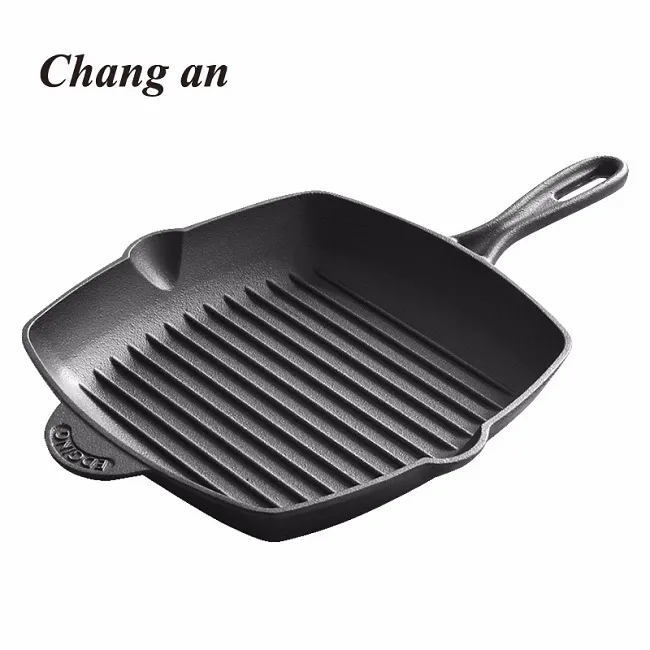
The material characteristics of Cast Iron Grill Plate are the foundation of its roasting strength
The entire cast iron grill pan is made of high-purity cast iron cast in one go, with a thickness usually reaching 1015 millimeters. This thick texture gives it excellent heat storage capacity. When the baking plate is fully heated, it can maintain a stable temperature for a long time. Even if cold ingredients are frequently added, the surface temperature will not fluctuate sharply, avoiding local burning or undercooking of ingredients due to uneven heating. At the same time, the unique heat conduction method of cast iron allows heat to evenly penetrate from the surface into the interior of the food, forming a perfect taste of crispy on the outside and tender on the inside, which is an advantage that ordinary metal baking plates cannot match.
Compared to multifunctional grills, the design of Cast Iron Grill Plate is more "specialized"
Cast iron grill frying pan usually adopts a flat and wide rectangular or circular board surface, without extra grooves or grilles, and only has a shallow oil guide groove at the edge, which can collect the oil seeping out of the ingredients, prevent dripping from causing open flames, and not excessively scorch the corners of the ingredients like a grille grill. Some styles are designed with anti slip feet at the bottom of the baking board, which can be stably placed on charcoal fires, gas stoves, or electric ovens, and are compatible with multiple heating sources; Some are also equipped with foldable wooden handles, which are convenient to move and can isolate high temperatures to prevent burns.
Cast Iron Grill Plate is suitable for pure grilling needs
In home barbecue, cast iron grill cookware can perfectly handle large pieces of meat such as steak and lamb chops. Under the charred shell formed by high-temperature grilling, the meat juice is firmly locked in, and the flowing meat juice when cut emits a tempting aroma; When grilling vegetables, a flat surface allows asparagus, mushrooms, colored peppers, etc. to be evenly heated, with slightly charred edges without losing moisture, preserving the sweetness of the vegetables. When having an outdoor picnic, it is a portable and reliable companion. It can grill delicious food comparable to professional barbecue restaurants on a charcoal fire, and it is easier to clean up than a grill.
The maintenance method of using Cast Iron Grill Plate is simple but crucial
After each use, let the grill cool to a slight temperature and use a hard bristled brush dipped in hot water to remove any remaining food debris, avoiding the use of detergent to damage the oil film formed on the surface. After wiping off the moisture, dip a small amount of cooking oil in kitchen paper and evenly apply it to the surface of the baking board. Heat over low heat until smoke rises, allowing the oil to fully penetrate the surface of the cast iron. This oil film will become stronger with increasing use, preventing rust and enhancing non stick properties. When not in use for a long time, it is necessary to thoroughly dry and apply grease, and place it in a dry and ventilated place.
The cast iron griddle skillet occupies a unique position in barbecue kitchen utensils with its pure grilling performance and heavy texture. It abandons complex functions and focuses on maximizing the relationship between heat conduction and ingredient grilling, achieving extraordinary deliciousness with simple design. Whether it's a warm barbecue for family gatherings or a fireworks feast for outdoor camping, Cast Iron Grill Plate has become an indispensable hardcore equipment for barbecue enthusiasts with its stable performance and authentic flavor, interpreting the cooking philosophy of "less is more".
Cast Iron Grill Plate FAQs
What foods are suitable for cooking with Cast Iron Grill Plate?
Cast Iron Grill Plate is perfect for frying grilled meats (such as steak, pork chops, chicken chops), seafood (such as salmon, prawns), vegetables (such as mushrooms, peppers, asparagus), and breads (such as panini, toast) due to its excellent thermal conductivity and insulation properties. At high temperatures, it can quickly form a coking layer, lock in the moisture of ingredients, and give a unique charcoal grilled aroma. It is recommended to preheat for 1015 minutes before baking, and brushing the surface of the food with oil can avoid sticking.
-
How to properly boil and maintain Cast Iron Grill Plate?
The newly purchased Cast Iron Grill Plate needs to be "boiled" to form a rust proof oil film: clean and dry, evenly apply cooking oil (such as flaxseed oil or lard), put in the oven at 200 ℃ for 1 hour, repeat 23 times. Avoid using detergent during daily cleaning, wipe with hot water and a soft cloth, and apply a thin layer of oil to prevent rust after drying. If it rusts, it can be polished with coarse salt and reheated to restore it.
What are the advantages and disadvantages of Cast Iron Grill Plate compared to non stick baking pans?
Cast Iron Grill Plate has strong durability, with a lifespan of several decades, high temperature resistance (suitable for open flames and ovens), and a richer baking flavor. However, it requires regular maintenance and is relatively heavy. Non stick baking tray is lightweight and easy to clean, suitable for low-temperature quick frying, but the coating is prone to scratching and may release harmful substances at high temperatures. We recommend cast iron models for pursuing cooking quality and versatility, while non stick models are preferred for convenience.
Why does Cast Iron Grill Plate need sufficient preheating?
Cast iron has slow thermal conductivity but strong heat storage capacity. Adequate preheating (510 minutes on medium to low heat) can evenly distribute heat and avoid uneven heating of food. Untreated baking trays may cause food to stick to the bottom or become undercooked. Can be tested with water droplets: rapid vaporization after dripping indicates sufficient temperature. After preheating, adjust to medium and small fire to maintain stable temperature and save energy.
How to make the perfect steak with Cast Iron Grill Plate?
Select a 23cm thick steak, dry the surface at room temperature, sprinkle salt and black pepper for seasoning. Preheat the baking tray over high heat until smoke rises, pour in a small amount of high smoke point oil (such as avocado oil), put in the steak and fry on each side for 1.52 minutes until crispy, then fry on the side and seal the edges. After turning off the heat, add butter, garlic, and rosemary, tilt the baking tray and drizzle over the surface of the steak. Let it stand for 5 minutes before cutting it into pieces, with a pink center and full juice.
-
China PC Light Cast Iron Wok Traditional Heat with Modern Weight
NewsApr.16,2026
-
Professional Guide to China Cleaning Cast Iron Wok Maintenance
NewsApr.09,2026
-
Explore the Benefits of a China Cast Iron Grilling Wok for Your Kitchen
NewsApr.07,2026
-
China Victoria Cast Iron Wok A Comprehensive Guide to Quality Cookware
NewsApr.04,2026
-
Discover the Superior Quality of China Enameled Cast Iron Wok Cookware
NewsMar.31,2026
-
Discover the Benefits of a China Cast Iron Wok with Lid for Authentic Cooking
NewsMar.28,2026